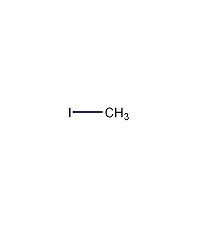
structural formula
| business number | 01hl |
|---|---|
| molecular formula | ch3i |
| molecular weight | 141.94 |
| label |
methyl iodide, monoiodomethane, methyl iodide, methylation reagents, extinguishing agent, halogenated hydrocarbon solvents |
numbering system
cas number:74-88-4
mdl number:mfcd00001073
einecs number:200-819-5
rtecs number:pa9450000
brn number:969135
pubchem number:24857202
physical property data
1. properties: colorless and transparent liquid with a special odor. turns brown when exposed to light. [12]
2. melting point (℃): -66.5[13]
3. boiling point (℃): 42.5[14]
4. relative density (water = 1): 2.3[15]
5. relative vapor density (air=1): 4.89[16]
6. saturated vapor pressure (kpa): 50 (20℃)[17]
7. heat of combustion (kj/mol): -813.8[18]
8. critical temperature (℃): 254.8[19]
9. critical pressure (mpa): 7.36[20]
10. octanol/water partition coefficient: 1.51~1.69[21]
11. solubility: slightly soluble in water, soluble in ethanol and ether. [22]
12. refractive index at room temperature (n25): 1.5270
13. eccentricity factor: 0.193
14. solubility parameter (j·cm-3)0.5: 20.172
15. van der waals area (cm2·mol-1): 4.600×10⁹
16. van der waals volume (cm3 ·mol-1): 32.850
17. gas phase standard claims heat (enthalpy) (kj·mol-1): 14.7
18. gas phase standard entropy (j·mol-1·k-1): 253.81
19. gas phase standard free energy of formation (kj·mol-1): 16.4
20. gas phase standard hot melt (j·mol-1·k -1): 44.08
21. liquid phase standard claims heat (enthalpy) (kj·mol-1): -12.3
22. liquid phase standard entropy (j·mol-1·k-1): 162.8
23. liquid phase standard free energy of formation (kj ·mol-1): 16.5
24. liquid phase standard hot melt (j·mol-1·k-1):82.91
toxicological data
1. acute toxicity[23]
ld50: 100~200mg/kg (rat oral)
lc50: 1300mg/m3 (rat inhalation, 4h)
2. irritation[24] human transdermal: 1g (30min), mild irritation.
3. mutagenicity [25] microbial mutagenicity: salmonella typhimurium 2μl/dish; escherichia coli 20μmol/l. mammalian somatic cell mutagenicity: mouse lymphocytes 15mg/l (2h). dna damage: e. coli 1μmol/l.
4. carcinogenicity [26] iarc carcinogenicity comment: g3, insufficient evidence of carcinogenicity to humans and animals.
ecological data
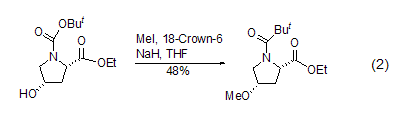
<ester. phenolic hydroxyl groups can often also be methylated under such conditions[3], while fatty alcohol methylation usually occurs in aprotic polar solvents using stronger bases (formula 2) [4].
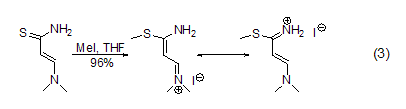
s -methylation methyl iodide can methylate sulfides such as thiols [5] to obtain sulfides and sulfonium salts. for example, the reaction between thioamide and methyl iodide in thf can methylate thio to form thioether (formula 3)[6].
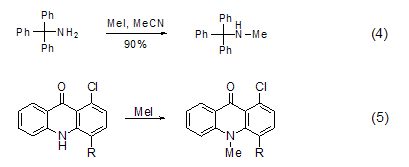
n -methylation methylation of ammonia and primary amines with methyl iodide is generally not a good method because further methylation will occur, but for secondary and tertiary amines methylation is a better method and can be used to prepare tertiary amines and quaternary ammonium salts[7]. in acetonitrile solvent, tritylamine is methylated with methyl iodide to obtain the product with higher yield (formula 4)[8]. the nitrogen atoms in the heterocyclic ring can also be methylated with methyl iodide (formula 5)[9,10].
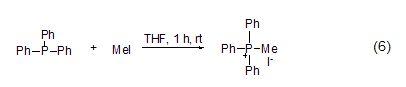
p -methylation the reaction between three-coordinated phosphorus and methyl iodide can generate salt (formula 6) [11]. usually, this reaction occurs in polar solvents such as acetonitrile, perform in dmf or thf.
3. used in medicine, organic synthesis, testing of pyridine, microscopy, etc. [35]
 微信扫一扫打赏