
background and overview[1]
phenyl trifluoromethanesulfonate, also called phenyl triflate, can be used in organic synthesis and can be obtained by acylation of phenol.
preparation[1-3]

phenyl triflate: triflate (10g, 35mmol) was added dropwise to a solution of phenol (3.16g, 35mmol) in pyridine (60ml) at 0°c and argon. the mixture was stirred for 24 hours, keeping the temperature below 5 °c, then poured into diethyl ether (100 ml) and washed with water (3 x 60 ml). the organic portion was dried (mgso4) and evaporated under reduced pressure to give the triflate (0.93g, 77%); 1h nmr (cdcl 3, 400 mhz): δ 7.24-7.26 (2h, m), 7.35-7.36 (1h, m), 7.39-7.43 (2h, m). 13c nmr (cdcl 3, 100 mhz): δ 114.1-126.6 (cf3, q, j = 310 hz), 121.3, 128.4, 130.3, 149.7.
method 2, phenyl triflate and 18g in the picture below, can be prepared by 4-iodo phenyl triflate under the catalysis of palladium acetate.
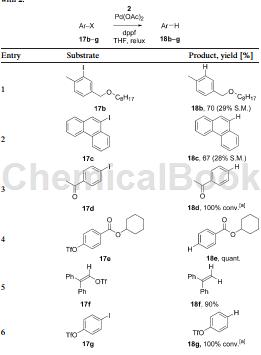
apply[4]
can be used to prepare (s)-tert-butyl 2-phenylpropionate.
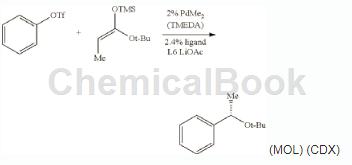
in an argon-filled glove box, add pdme2 (tmeda) (2.5 mg, 0.010 mmol), (r)-2-(dicyclohexylphosphine) to a dry 4 ml vial base)-2′-(2-naphthylmethoxy)-5, 5′, 6,6′, 7,7′, 8,8′-octahydro-1,1′-binaphthyl l6 (7.4 mg , 0.012 mmol) and 1.0 ml of dry α, α, α-trifluorotoluene. after stirring at 25°c for 30 minutes, add anhydrous lioac (66 mg, 1.0 mmol), phenyl triflate (113 mg, 0.50 mmol), (1e)-1-tert-butoxy-1-(trifluoromethanesulfonate) in sequence. methylsiloxypropylene (152 mg, 0.75 mmol) and gc standard n-dodecane (50 μl). cap the vial tightly and stir the mixture in a 50°c (internal temperature) heating block.��hot. after complete consumption of phenyl triflate within 18 h at 50 °c (monitored by oc and tlc), the reaction mixture was cooled to 25 °c and filtered through a pad of silica gel with ether washes (20 ml). the filtrate was concentrated and the residue was purified by flash silica gel chromatography using ethyl acetate/hexane (1:40) as eluent to give the title compound as a colorless oil (96 mg, 93% yield).
main reference materials
[1] sabin, margaret v . synthetic studies on two silicon assisted annulation reactions.[j]. aiche journal, 1994, 55(55):594-611.
[2] zhu s , wang c , chen l , et al. modular approach for synthesis of vicinal diamines containing axial chiral 1,1′-binaphthyl from 1,2-diaminoethane by pd-catalyzed n-arylation reactions[j ]. organic letters, 2011, 13(5):1146-1149.
[3] chu q , brahmi m m , solovyev a , et al. ionic and organometallic reductions with n-heterocyclic carbene boranes[j]. chemistry, 2009, 15(47):12937-12940.
[4] (us20150166586) chiral phosphines for palladium-catalyzed asymmetric α-arylation of ester enolates to produce tertiary stereocenters in high enantioselectivity
 微信扫一扫打赏